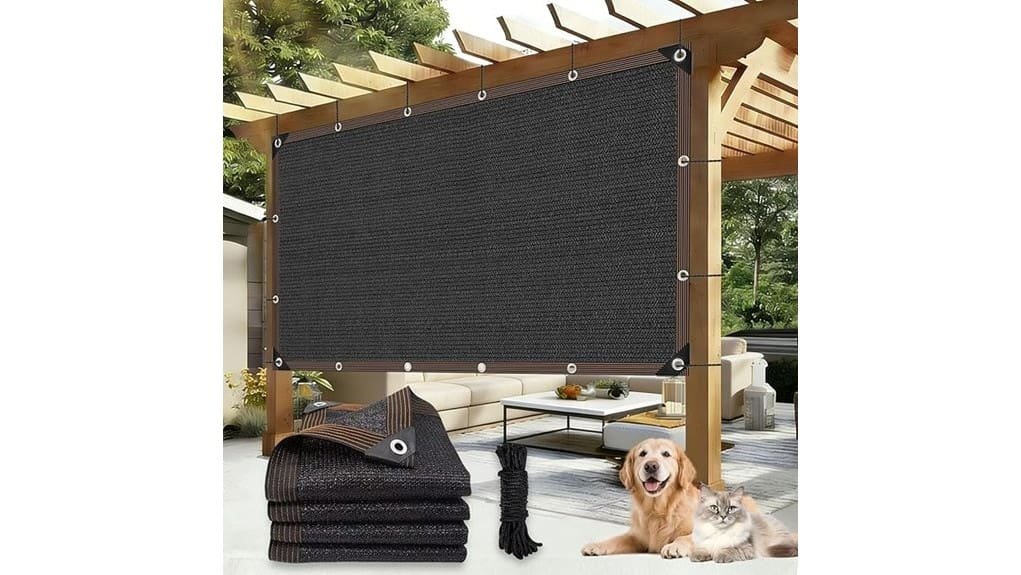

You’ll get a durable 5×10 ft HDPE mesh that blocks about 90% of sunlight and most UV while letting air and water pass, so it cools spaces without pooling. Reinforced edges, double grommets, and six-row seams resist tearing and concentrate load away from attachment points. It shows minimal stretch and predictable fit if you allow 3–5% extra for anchoring. Low maintenance and versatile, it’s practical for patios, greenhouses, and livestock—keep going to see installation and care tips.
Some Key Takeaways
- HDPE woven 90% shade cloth blocks most sunlight and UV while allowing about 10% light transmission for plant-friendly diffused light.
- Reinforced perimeter and double grommets every ~20 inches provide reliable anchoring and distribute tension to prevent tearing.
- Mesh design promotes airflow and lowers ambient temperature beneath, reducing heat stress for plants and seating areas.
- Rainwater passes through mesh, preventing pooling and slightly increasing soil moisture—pair with sealers for longer outdoor life.
- Easy low-maintenance installation: measure with 3–5% extra, retension seasonally, hose off debris, and store dry.
Quick Verdict : Is the 90% 5×10 Ft Shade Cloth Worth Buying?
Wondering if the 90% 5×10 ft shade cloth is worth buying? You’ll find it delivers strong shade and airflow, cutting sunlight and heat while letting water pass. Do a quick cost analysis: price aligns with durable HDPE and reinforced edges, so value matches expected lifespan. Check user reviews for real-world notes on size variance, ease of hanging, and temperature reduction; most report satisfactory cooling and longevity. You’ll appreciate low maintenance and broad applications from patios to greenhouses. If you need heavy waterproofing or decorative finishes, consider alternatives, but for functional shading this is a practical choice. Many homeowners use these covers with retractable pergolas to enhance patio comfort and flexibility.
What the Fabric and Build Tell You : HDPE Mesh, UV Blocking, Grommets, and Stitch Details
Because the 90% shade cloth is woven from high-density polyethylene (HDPE), it gives you a lightweight yet tear-resistant mesh that blocks over 90% of sunlight and most UV while still allowing about 10% light transmission and steady airflow. You’ll notice consistent UV resistance in the fibers, reducing photodegradation and color fade. Edge reinforcement runs the perimeter, preventing fray and concentrating load away from grommets. Double grommets are spaced for reliable anchoring; seams show six-stitch rows that distribute tension and resist tearing. Overall construction reads as purpose-built: minimal stretch, predictable performance, and straightforward installation. Many homeowners use similar mesh tarps to keep insects out while enjoying their patio spaces, especially when outfitting outdoor seating areas.
Real-World Performance : Shade, Temperature Drop, Ventilation, and Water Drainage
When you set up the 90% shade cloth over a patio, greenhouse, or garden bed, you’ll immediately notice a marked reduction in direct sunlight and a perceptible drop in ambient temperature beneath the fabric. You get consistent shade uniformity across the covered area; darker midday spots become comfortable without creating harsh light gradients. The HDPE mesh keeps temperatures lower by blocking UV and allowing hot air to escape through the fine weave, so ventilation remains effective. Rain passes through the mesh, preventing pooling and maintaining normal moisture drainage while slightly increasing moisture retention in soil below—useful for thirsty plants. For added longevity and to maintain effective protection in outdoor settings, consider pairing shade cloth with weatherproofing sealers recommended for patio surfaces.
Where It Works Best : Top Garden, Greenhouse, Patio, Livestock, and Equipment Use Cases
Although designed primarily for heavy shade, the 90% HDPE shade cloth adapts well to a wide range of garden and outdoor uses, offering targeted protection without trapping heat or water. You can shade a rooftop garden or pergola to reduce solar load and enable delicate potted plant growth, using the fine mesh for airflow and heat mitigation. In greenhouses it limits light intensity while preserving ventilation, improving plant stress tolerance. On patios it creates cool seating and adds backyard privacy. For livestock and equipment it reduces UV exposure and surface temperatures, prolonging material life and improving animal comfort. It also pairs nicely with self-watering planters to help maintain consistent moisture levels while reducing sun stress.
Installation, Care, Sizing Tips, and How to Avoid Fit/Stretch Issues
If you want a snug, long-lasting installation, plan your layout and anchoring before stretching the 90% HDPE shade cloth into place. Use installation tips: measure twice, allow 3–5% extra for anchoring, mark grommet positions every 20 inches, and attach with bungee or coated wire to reduce point loads. For sizing guidance, account for expected shrink/stretch and trim only after weathering. Adopt a simple care routine: hose off debris, air-dry, inspect seams and grommets, and store dry. For stretch prevention, avoid over-tensioning, relieve wind load with vents, and retension seasonally to maintain fit. Consider pairing shade cloth with outdoor roller shades to enhance your patio’s comfort and sun control.
Some Questions Answered
Does the Shade Cloth Block Pollen or Fine Dust Particles?
No — it won’t fully stop pollen or fine dust particles. You’ll get some pollen filtration and dust rejection because the HDPE fine mesh blocks larger debris and reduces airborne load, but the ~10% light-transmitting openings still let fine pollen and dust pass. You should treat it as partial filtration for settling and larger particulates, not a sealed barrier; combine with finer filters or enclosure methods if you need near-complete exclusion.
Is the Material Pet- and Chew-Resistant?
No, it isn’t fully chew-resistant; you should treat it as pet safe materials but not biteproof. The HDPE mesh is tear-resistant and fade-proof, offering reasonable chew resistance against curious pets, but determined chewers can damage it. You’ll want to supervise pets around it or add protective barriers. For long-term pet areas, consider heavier-duty or metal options to guarantee true chew resistance and lasting safety.
Can the Cloth Be Used as a Privacy Screen Between Neighbors?
Yes — you can use it as a privacy screen and boundary divider. The 90% shade blocks most views while allowing airflow; HDPE mesh resists tearing and fading, so it holds up outdoors. Install using the reinforced edges and grommets every 20 inches for secure attachment. Expect some light transmission and slight stretch over time; spacing and seam strength give reliable coverage, but it won’t be completely opaque or chew-proof.
Will It Fade or Change Color in Extreme Climates?
Yes — it resists fading but can slowly lighten in extreme climates. You’ll get good UV stability from HDPE construction, so color changes are minimal compared with untreated fabrics. Manufacturers typically perform Colorfastness testing to verify resistance, but prolonged, intense sun and heat will eventually degrade pigments. You should expect long service life if you mount it properly and rinse it occasionally, yet plan for gradual, minor color fading over years.
Is the Shade Cloth Recyclable at End of Life?
Yes — you can sometimes recycle it, but options vary. Because it’s made from HDPE, many municipal recycling programs accept similar plastics; check local rules. Recycling options include drop-off at plastic recycling centers or specialty textile recyclers. Disposal challenges arise from dirt, metal grommets and mixed materials, which can contaminate streams. If recycling isn’t available, consider repurposing the cloth or using proper waste disposal to avoid landfill contamination.